

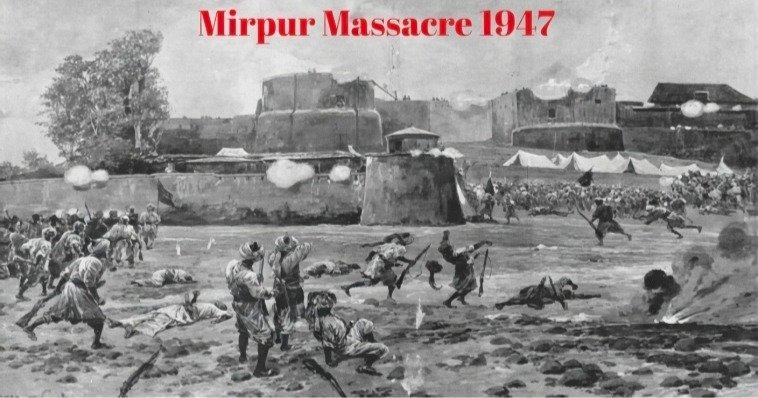
November 25, 1947 remains “A day that stands among the worst in history when 20,000 Hindus and Sikhs were slaughtered, mutilated, and women were dishonored, being turned into captives with cruelty by Pakistanis.” 1947 is primarily remembered as the year of our Independence and the year that witnessed the India-Pakistan partition. This dreadful year also serves as a stark reminder of the most blood-curdling instance of carnage in Indian history. In Mirpur of today’s J&K, around 35 thousand Hindu and Sikh refugees were mercilessly slaughtered and innumerable women were raped. The conspirators were armed Pakistani tribals and soldiers who carried out the first ever Kashmir war on and around November 24-25. The date – 25th November, a wretched day in history, is thus remembered as ‘Mirpur Day’.
During the partition of India and Pakistan in 1947, thousands of Hindus from Pakistan had migrated to Mirpur from Punjab and the Muslims from Mirpur had moved to Pakistan. Mirpur was then a part of the erstwhile princely state of Jammu and Kashmir. As the offer of accession by the Maharaja was accepted by the Govt of India on the 26th of Oct. 1947, little did the Hindu and Sikh minorities living in Muslim majority western areas of the Jammu region and in the Kashmir valley, know what awaited them. The decision of the accession of J&K with India and its complete merger with India as its integral part was welcomed by one and all and thus was hugely celebrated in Mirpur. But the United Kingdom had decided that the Princely State of Jammu and Kashmir or part of it must go to Pakistan for reasons of strategic importance. The very creation of Pakistan itself was a result of strategic dynamics.
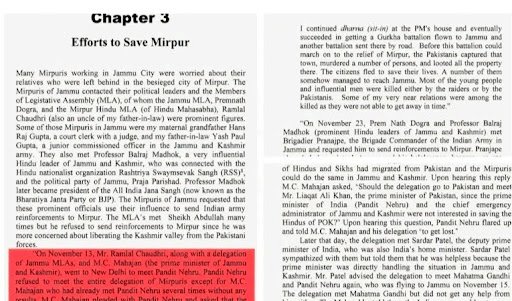
As a result, the Pakistan Army conceived a military plan to invade Jammu and Kashmir, under the guise of a military campaign. They code-named this conspiracy as ‘Operation Gulmarg’. It is widely known that this strategy was planned and executed with the assistance and guidance of the British. Mirpur city was guarded by 800 soldiers of the J&K forces, half of which were Muslims. Those Muslim soldiers deserted their posts, taking with them their arms & ammunition and joined the invading Pak Army. The remaining J&K soldiers kept the Pakistani raiders at bay till the 16th of Nov 1947 . “By the time the Indian Army started its march towards Mirpur from Jhangad and had captured an area up to 15 kms from 10 to 14 Nov, they were stopped.”* Sheikh Abdullah prevented the Indian Army from marching ahead. Hindu Mahasabha MLA R.C. Sadavarti, alongside other political leaders, met Sheikh Abdullah multiple times to save Mirpur, but he declined the proposal to send reinforcements. Sadavarti also visited Delhi with MC Mahajan to meet Nehru, yet the latter refused to meet any member of the delegation save Mahajan.
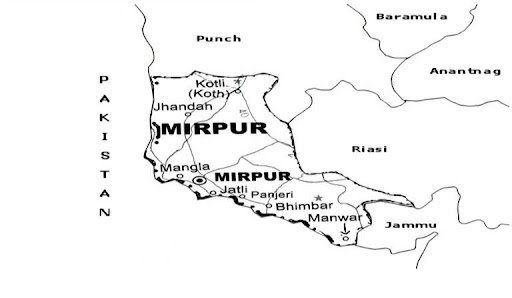
A major attack was carried out by the enemy forces on the 23rd of Nov 1947 from the main eastern gate which was repulsed by the death squads consisting of Mirpuri youths in a hand to hand fight. The youth of Mirpur stood with the soldiers on the defence posts for days at end but owing to a lack of local support and weapons and the growing number of Pakistani armed invaders, they encountered ill fortune. In a stroke of bad luck, the only wireless equipment which the state forces possessed, broke down and the fresh, stronger attack by the enemy forces on the morning of the 24th, frightened the state forces who left the battle scene after informing civilians to move to safer places. On the gruesome morning of November 25, the Pakistan army and tribesmen entered the city and set several parts of the city on fire, causing chaos and turmoil across the city. Large-scale riots took place.
The residents of Mirpur had pledged to not let Pakistani invaders enter the city and hence fought them to their last breath but that dark day had by then claimed thousands of lives. This sanguinary dance of death continued till the afternoon and by the end of day, 18000 people had been slaughtered in the most barbaric fashion, unprecedented in human history, by the Pak army and tribals. Around 15K Hindus and Sikhs managed to escape the city and marched along unknown paths. The Pakistanis killed 1000s of the captives along the way. Thus, only about 5000 made it to Alibeg camp, where a Gurdwara had been converted into a refugee camp, but was in fact used as a prison.
Only 2000 people could reach Janger on foot and then, escorted by the Indian army, to the Jammu refugee camp. Countless women were raped and abducted. To avoid these horrors, numerous women committed mass suicides by consuming poison before they fell into the clutches of these terrorists. Many who didn’t get access to poison were hacked to death with swords by their fathers and brothers. Men too committed suicides.
In the northern part of Mirpur were Gurdwara Damdama Sahib and the Sanatan Dharma Temple. There lay a large lake and a deep well between them. It is said that an Arya Samaj school hostel located in close proximity to this area had some 100 female students then. The hostel superintendent had asked the girls to tie their dupattas to their heads, jump into the well and pray to God before dying so that they may take re-birth as men and not women in their next lives. Later she too took her own life. The well was so deep that even its water was not visible.
On and around 25th November, the Pakistan army captured around five thousand Hindu girls. Many of these were raped, exploited and later sold in Pakistan, Afghanistan and Arab countries. The tribesmen chased people, young or old, girls and women almost everywhere, murdered them and looted the city. Meanwhile, the runaway Muslims returned to Mirpur and participated in plundering the city. They all knew exactly the amount of goods and gold kept in specific houses. The whole of Mirpur was dug out to loot the wealth worth billions of rupees besides gold and silver.
The estimates measure the death toll at over 20,000.
Before the occurrence of this horrendous incident, the Mirpur District had about 75000 Hindus and Sikhs, amounting to about 20 % of the population. Refugees from Jhelum in western Punjab had taken refuge in Mirpur town, causing the non-Muslim population to increase by 25000.
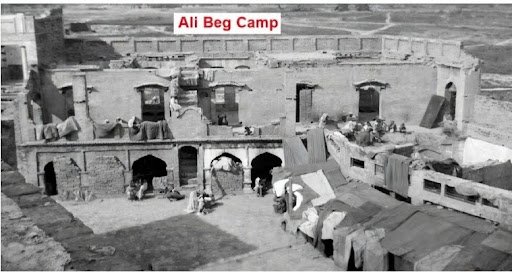
Sardar Muhammad Ibrahim Khan, the then President of ‘Azad Kashmir’, who had visited the place during the event, had painfully confirmed that Hindus were ‘disposed of’ in Mirpur in November 1947, though he didn’t mention any figures. Currently Mirpur is in Pakistan Occupied Jammu and Kashmir but there is no sign of the old Mirpur. Pakistan has submerged the old Mirpur by constructing the Mangala Dam on the Jhelum River. Most of the residents there have now settled in London and Pakistan has changed the demography of the place while also destroying its cultural fabric. There remain only the ruins and remains of some temples, if any. In March 1948, the ICRC (International Committee of the Red Cross) rescued 1,600 of the survivors from Alibeg, who were then resettled in Jammu and other parts of India. By 1951, only 790 non-Muslims remained in areas that came to comprise Pakistan Occupied Jammu and Kashmir, down from a population of over 114,000 who used to live there.