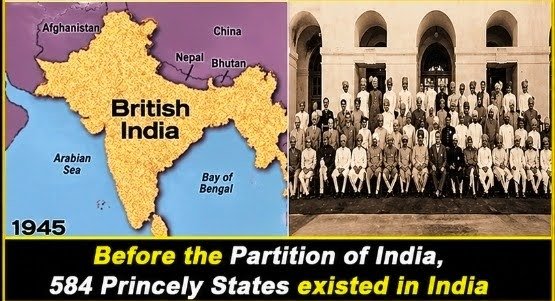
Prior to the partition in 1947, British rule over India consisted of two different sets of geographical regions. One contained various provinces administered by the Viceroy of India. This set constituted 60% of the total land area of the sub-continent and was referred to as British India. The second set consisted of regions ruled by Maharajas, Princes, Nawabs, etc. There were 562 Princely states in total of which 327 were petty states. All of these were collectively designated as the “Indian States”. The British looked after the matters of defence, foreign policy and communications for these States though they were allowed to govern internal matters such as law and order, civil liberties, health, education and economic development. The State of Jammu and Kashmir was one such state.
On the 20th of February 1947, His Majesty’s Government announced that independence would be granted to British India. At a meeting held on the 25th of July 1947, Mountbatten advised the princes that they should accede to one of the two dominions, keeping in mind the ‘geographical contiguity of their States’, while surrendering power over three specified subjects, without any financial liability.
The Maharaja of Jammu & Kashmir in 1947 was Hari Singh of the Dogra Dynasty. His official title was Shriman Indar Mahander Rajrajeshwar Maharajahiraj Shri Hari Singh Ji Jammu and Kashmir Naresh Tatha Tibet adi Deshadhipathi Ruler of Jammu and Kashmir.
By the 15th of August 1947, the final boundary line separating independent India from the newly created dominion of Pakistan had not been declared along the West Pakistan side (West Punjab). Thus, the surface links for the princely state of Jammu & Kashmir were not yet clear. The Radcliffe award was announced after the 15th of August. Therefore, Jammu and Kashmir had not acceded to either India or Pakistan by this date.
The borders of the Princely State of J&K adjoining West Pakistan remained especially disturbed after the 14th of August 1947. By the end of the third week of October that year, a force of several thousand armed men (pathans/ tribals) aided and abetted by Pakistan Army regulars openly invaded the then Princely State of Jammu and Kashmir. The Maharaja of J&K requested the Indian government for material and military assistance on the 24th of October, 1947. On the 26th of October 1947, Maharaja Hari Singh signed an unconditional ‘Instrument of Accession’ with India. The draft of the Instrument of Accession was the same as had been signed by other acceding Princes of the erstwhile British Indian Empire.
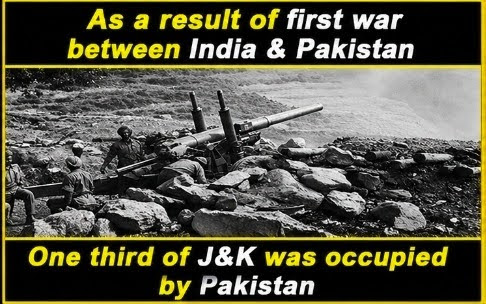
The Indian Army and Air Force were moved to the Kashmir Valley on the 27th of October and consequently, a large part of the Kashmir Valley was cleared of the Pakistani aided and abetted invaders before the ceasefire came into effect. However, a large area of the Jammu & Ladakh Regions and a part of the Kashmir Valley remained under the illegal occupation of Pakistan (POJK). The reason behind these areas not being cleared of the enemy’s occupation when the ceasefire was declared only on the 1st of January, 1949 remains a mystery even today. As a result of this first war between India & Pakistan, about one third of J&K was occupied by Pakistan and remains so even today. It is now known as Pakistan-occupied Jammu and Kashmir.
The accession of the State was full and final. The accession of Jammu&Kashmir with the then Indian Dominion was fully legitimate and valid since it had been executed by the only authority that was nominated under the Indian Independence Act, 1947. The total area of the state of Jammu and Kashmir was 2,22,236 sq. kms. Today India controls only 1,01,387 sq.km of this area. The rest of this area is under the illegal occupation of Pakistan and China. (Region-wise break up of these statistics can be provided if required)
Integration of Jammu and Kashmir with India
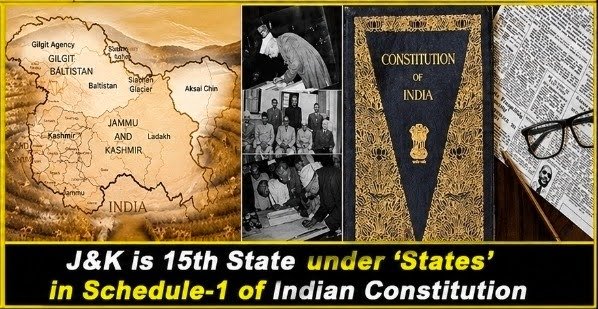
Article-1 of the Constitution of India itself includes J&K as the 15th State under ‘States’ in Schedule-1 of the Constitution.
The Preamble of the Jammu – Kashmir Constitution states –
We, the people of the State of Jammu and Kashmir, having solemnly resolved, in the presence of the accession of this State of India, which took place on 26th day of October, 1947, to further define the existing relationship of the State with the Union of India as an integral part of India as an integral part thereof, and to secure to ourselves:- ……
Thus, as per the Preamble of the erstwhile State’s Constitution, Accession had taken place on the 26th of October. The Jammu and Kashmir State’s Constitution had further defined the relationship of the State with the Union.
Section- 3 of the Jammu and Kashmir Constitution too had laid down that J&K is and shall remain an integral part of India.
(Section- 3 of the Jammu and Kashmir constitution : Relationship of the State with the Union of India:-The State of Jammu and Kashmir is and shall be an integral part of the Union of India).
Even if Article 370 is abrogated, Article-1 of Indian Constitution remains operational. The Constitution of J&K stays too and by that measure so does Section-3 of the J&K Constitution (Relationship of the State with the Union of India:-The State of Jammu and Kashmir is and shall be an integral part of the Union of India).
Even the J&K Assembly cannot amend Section-3 of the J&K Constitution as has been clearly laid down in Section-147 of the same document.