

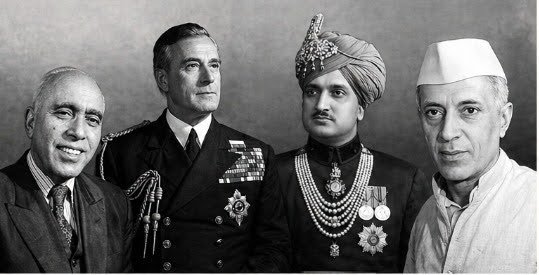
With the signing of the Instrument of Accession (IoA) by the then ruler of Jammu and Kashmir Maharaja Hari Singh on the 26th of October, 1947, J&K became an integral part of India. This accession was full, complete and irrevocable. Though Pakistan and its cronies in India have been spreading falsehoods that the Maharaja did not take the wishes of the people of the state into consideration while acceding to India, it is important to realise that this is not true. The sequence of events that occurred later makes it amply clear that the Maharaja and the people of the state were on the same page on the question of accession. The subjects of the erstwhile princely state had clearly conveyed their wishes in favour of the accession of the state to India. It is important to note here that despite the letter of Mountbatten having no legal significance in the matter of accession, India still adopted two of the mechanisms that Mountbatten had suggested for ascertaining the wishes of the people.
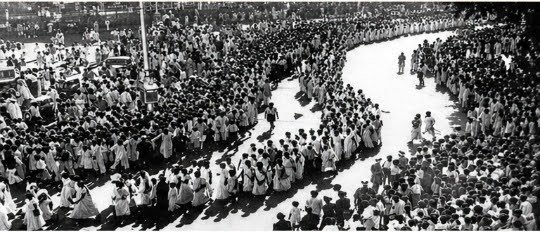
An overview of facts delineating people’s mandate and the accession of Jammu and Kashmir
Following are some important facts, which clarify that the accession of J&K was legal and that the people had conveyed their wishes for the same:
- The Instrument of Accession was a legal instrument used by all princely states, whether they acceded to India or Pakistan. This instrument was designed after much deliberation by the British and the concurrence for the same was given by the respective rulers of the princely states. This instrument clearly left it to the wisdom of the ruler of the state to accede to either of the dominions. Though certain media houses have reported that some people wanted to replace the rule of the dynasty, it is an undeniable fact that Maharaja Hari Singh was the sole recognised and legally qualified person to make the decision on the matter of accession.
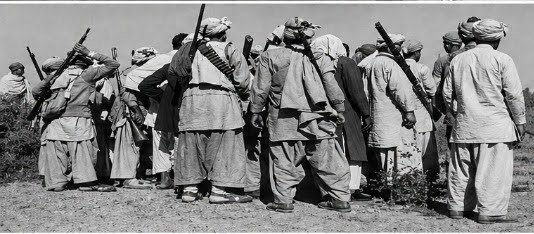
- There is no such record from that time, which suggests that the people were against the decision of the Maharaja. On the contrary, the documents show how brutally the administrative structure was crushed by Pakistani mercenaries and the manner in which people had to run away from their houses to save their own lives. The affected areas during this bloodbath were Bhimbar, Kotli, Mirpur, Mujjafarabad and Rajouri, where thousands of men, women and children were slain in a single day. According to one estimate, more than 10 Lakh people were displaced from Jammu and Kashmir during this bloodbath. Currently, all these areas except Rajouri are under the illegal occupation of Pakistan. Documents also speak volumes about how barbarically males and children were butchered and females raped during this terrible time. This made the people of the state look upto India for help and it was quite obvious that they would stand by the decision of the Maharaja.
- The tallest leaders, at that point of time, of Jammu and Kashmir like Sheikh Abdullah from Kashmir valley, Pandit Premnath Dogra from Jammu and Kushok Bakula Rinpoche from Ladakh fought against Pakistani invaders to safeguard the state from them. This clearly shows that pro-Indian sentiments were prevalent in J&K at that point of time.
- Sheikh Abdullah himself endorsed the accession of J&K to India, while making speeches at the United Nations Security Council (UNSC) on the 5th of February, 1948 and in the J&K Constituent Assembly on the 5th of November, 1951. In his speeches, he categorically mentioned why he wishes that the state of J&K should accede to India and not to the Muslim majority country i.e. Pakistan. He also mentioned that he does not believe in the two nation theory or communalism itself. Further, he lamented the massacre of the residents of the state. He was even ready to justify the accession of the state to India. In his speech in the UNSC, he categorically mentioned that Maharaja Hari Singh and the people of the state were on a common platform while acceding to India. He even mentioned that the Prime Minister of India showed a gesture of gratitude when he said ‘India does not want to take advantage of the difficult situation in Kashmir’ and will seek the consent of the people of the state once it is freed from Pakistani invaders.
- The Lord Mountbatten letter of 27th October, 1947 has no legal sanctity as there was no pre-condition in the entire process of accession, which legally binds the ruler to take people’s wishes into consideration. Further, there was no opposition or protest against the decision of the Maharaja. On the contrary, people participated in the election process of the Constituent Assembly so that it could prepare the Constitution of the state.
- Nowhere in history was it found that different sorts of instruments, containing specific conditions for any particular princely state(s), were used for accession. So, the Maharaja was the only legal person of consequence in the matter of the accession of J&K to either of the two dominions.
- The proceedings of the Constituent Assembly of the state on the 6th February of 1954 clearly mentioned that the Jammu & Kashmir Constituent Assembly ratified the IOA in favour of India. This Constituent Assembly had the representatives of the people of J&K who took the decision on the matter of Accession.
- The Indian government went to the UNSC against the Pakistani aggression in J&K and not for any dispute on the accession of the state. The same was accepted by the UNSC and it even asked Pakistan to vacate the piece of land occupied by it illegally though it was a different matter that the UNSC did not do anything to ensure that Pakistan complied with its resolution.
- Even the Government of India was ready for the plebiscite provided that the two conditions preceding the plebiscite must be fulfilled. These two conditions were a ceasefire by Pakistan and the withdrawal of Pakistani intruders from the soil of the state so that free and fair elections for the state could be conducted. But these two conditions were never fulfilled and the plebiscite, which was to ensue after the fulfilment of the two conditions, for the entire state, never happened. India waited for the international community to intervene in this matter and provide a peaceful resolution to the problems created by the Pakistani invaders in this part of the country but nothing happened in this matter. Therefore, on January 23, 1957 Mr. V. K. Krishna Menon, the Indian representative to the UN, made it clear in the United Nations Security Council (UNSC) that J&K including POJK belongs only to India.
- A Constituent Assembly of democratically elected leaders was formed to prepare the Constitution of the state. This Constituent Assembly was created, with the representation of democratically elected individuals chosen by the people of the state.
- The first general elections were held in the state in 1957 after the dissolution of the Constituent Assembly. They were held through a well-defined procedure for the same and a democratically elected government was formed in J&K.
- Lord Mountbatten, the then Governor General of India mentioned that there were four ways to ascertain the wishes of the people. These four ways were referendum, plebiscite, election or, even if these methods are deemed impracticable, representative public meetings (Mission With Mountbatten by Alan Campbell-Johnson, p.263). India has already exercised the last two options, i.e. election in the state and representative public meetings, to ascertain the wishes of the people.

The above facts make it amply clear that the myth of the so-called Kashmir problem has been created by certain cronies of Pakistan in the Kashmir valley, India and in the media houses. It is important to understand here that the Kashmir valley is one of the smallest portions (i.e. 7%) of the entire state and the number of separatist elements, which is considerable, is spread in a limited number of districts of Kashmir. But they have vast control over institutions like the media, the bar association of Kashmir etc., which are proving to be hindrances in disseminating accurate information in the entire country. Focus has always been laid on a select few people who twisted historical facts and separatists are some of these select people, who are given undue advantage. It is also evident that the discussion on J&K is limited to the smallest portion of land and the problems like detention of Kashmiri stone-pelters, Armed Forces Special Powers Act, are given more importance notwithstanding the existence of much bigger issues. It has been ingrained in the minds of the people that the wishes of the people of Jammu and Kashmir were never ascertained by India though it is not correct as depicted by the abovementioned facts.
The facts presented also break the myth that the people of J&K never wanted to accede to India. Also worth considering is the fact that tinkering with the well laid legal procedure would have opened the Pandora’s box and every princely state would have raised some demands on such flimsy grounds. It is also evident that the people were not consulted when the two nation theory was prepared and the decision on the same was taken to part India into two dominions. But that does not mean that people’s wishes were not heeded then. On the question of people’s wishes, I want to reiterate that the people used their vote to convey their wishes. Though Pakistan invaded J&K to terrorise its people, yet it failed in its dubious plans and the state was integrated with India.
Conclusion
In conclusion, it can be said that the accession of J&K to India is a matter of great pride. Though the people’s wishes were always taken into consideration, yet certain miscreants are spreading the canards about it and a sort of perplexing environment has been created across India including J&K in this regard. The reason for such confusion was obviously that the then government was unable to look beyond Sheikh Abdullah. Though there were certain sections in J&K who wanted that all the provisions of the Indian Constitution must be implemented in the state, like any other state in India, no one was against the accession of the state to India. So, it clearly shows that the residents of the state weren’t actually against the accession. Rather, Pakistan and its cronies were. I feel no person, who has an iota of common sense, would accept that the wishes of the people of the state were the same as those of their oppressor (i.e. Pakistan). It is strange that people spoke the language used by Pakistan and that unfortunately, their false propaganda was spread whereas the facts were never brought into the public domain.