

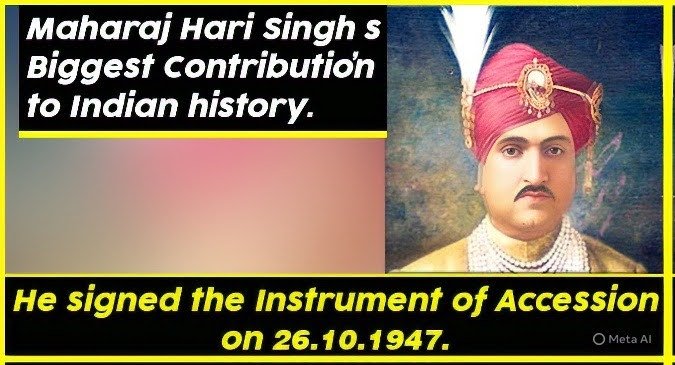
The erstwhile State of J&K was undergoing a struggle between the nationalist and separatist forces. Thus, it’s necessary to explore its history.
The Political Background of Jammu and Kashmir
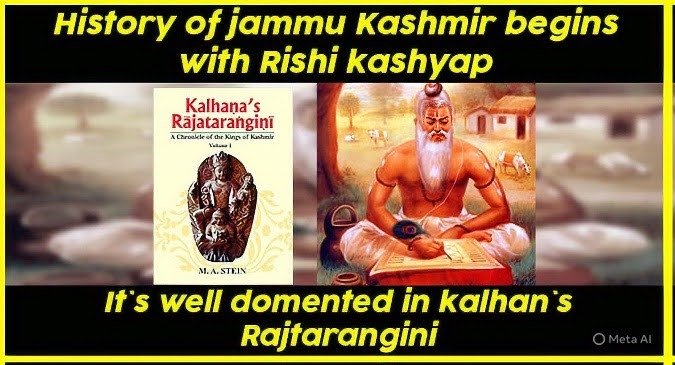
The history of Jammu and Kashmir is ancient. According to historical sources it begins with Kashyap Rishi. Kashmir, perhaps, is the only region in India which has a systematically documented history. The ‘Rajtarangini’ by Kalhan is a document of the same nature.
The history of Jammu is equally ancient. If one investigates thoroughly, sources can be traced up to the time of Mahabharata. The history of Ladakh, Gilgit and Baltistan is connected with the history of the Himalayas. The history of these regions is as old as the Himalayas themselves. However, the history of the principality/estate/princely state of Jammu and Kashmir, created by combining these five regions is not very old. It is quite recent. The credit of forming the principality of Jammu and Kashmir goes to Maharaja Gulab Singh. He was coronated in the year 1822, and there was no turning back for him since. By adding small estates like Gilgit, Baltistan and Ladakh, he became the ruler of a very large province. After the death of Maharaja Ranjeet Singh in Lahore, his army was scattered in the wars with the British in the Punjab region. Thus, Kashmir was taken over by the British. It was in 1846 that Kashmir was added to Jammu province, creating the second largest Princely state of India. When the first war of independence was being fought in 1857, Maharaja Gulab Singh passed away. A new chapter in the history of the state was added when the British started conspiring against the heir – Maharaja Hari Singh, the son of late Maharaja Gulab Singh. The British believed that Maharaja Hari Singh sympathised with the freedom fighters of India.
New researchers are now establishing the role of the then Muslim Conference (current National Conference) in cooperating with the conspiracies of the British. This cooperation may or may not have been deliberate. The British left India in 1947 and the country had to face the disaster of partition. Independence also put an end to the hereditary rule of more than 550 princely states. The princely hereditary rule of Jammu and Kashmir also came to an end but as a result of partition, one third of the principality was forcefully/illegally occupied by Pakistan. What remained of the state was also subject to various movements of separatism and integration by political parties. In these movements, the National Conference with its demand for autonomy and the Praja Parishad demanding integration created permanent footprints in this region. Praja Parishad was the first nationalistic movement of independent India. It’s ironic that the main demand of the Praja Parishad was full integration of the State with India yet the historians of independent India have forgotten this movement.
The Satyagraha held in Jammu and Kashmir by Praja Parishad is very significant in the history of independent India, as it had far reaching consequences. Although the Satyagraha had started with the formation of the Praja Parishad on the 17th of November 1947, the real ferocity of the movement was felt when Pt. Nehru and Shaikh Abdullah reached a consensus on the format of the Constitution of Jammu and Kashmir. The ground work of this movement had actually begun with the partition of India. After Maharaja Hari Singh signed the instrument of accession to integrate Jammu and Kashmir with India, Sheikh Abdulla was made the caretaker/emergency administrator(Aapatprashasak), but in 1949, with the exile of Maharaja Hari Singh, Abdullah began enjoying unrestrained powers.
This angered the nationalist forces not only in Jammu and Kashmir but all over India. After Nehru took the Jammu and Kashmir matter to the United Nations, the suspicion in the minds of the nationalists from the state became more intense. Amidst all the conflicts and debates, when Shaikh Abdulla started marginalizing the people from Jammu and Ladakh, in favour of the Sunni Muslims of Kashmir, to the extent that he even refused to accept them as parties to the entire issue, the nationalist forces of the state started unifying themselves. After all, the pride and identity of the people and the security of the nation was at stake. The situation worsened when Shaikh Abdulla started giving a communal colour to the issue of Jammu and Kashmir. He started demanding Special Status for Jammu and Kashmir, just because the state had a Muslim majority. He said “The Government of India time and again claims that India never accepted the Two Nation theory of Pakistan, nor was this country divided on communal lines. The claim of the Indian government is correct, but whenever the issue of Jammu and Kashmir is raised, it feels as if there is no better advocate of the Two Nation theory, other than India.”
It was natural that the nationalist forces would be quite disappointed with this communalization of the Jammu Kashmir issue. It was ironic that those opposing the communalization of the issue, were themselves called communal by Shaikh Abdulla. The efforts of Nehru and Abdullah to suppress this nationalist movement only served to add fuel to the fire. The discontent, which started brewing in 1947 spread like wildfire by 1952, and finally culminated in the Satyagraha of the PrajaParishad. In order to understand the background of this movement, it is important to understand the then political scenario and the political conspiracies of Britain.