

An examination of the ruins of ancient heritage in POTL (Gilgit-Baltistan) and the tragic state of shrines in the region.
Date & Author :
मई 21, 2026
. By Columnist: Jammu Kashmir Study Centre
Introduction
Gilgit Baltistan’s pre-Islamic past lives in monuments, rock carvings and artefacts and is being recovered daily. There are monuments dating back to the period of Emperor Ashoka and earlier. The proofs of a rich Hindu and Buddhist heritage lie scattered around the trade routes and passes. Karakoram road from Hunza to Chilas has nearly ten thousand rock carvings. There is not a lot of official information about the sites, and they lie in ruins. About 30,000 petroglyphs and 5000 graffiti have been discovered in and around the ancient trade routes in Gilgit-Baltistan. These have been preserved by a natural process termed as ‘Desert Patina’.
The ancient cultural linkages are strewn around. Brahmi, Kharosti, Sogdian, Bactrian, Tibetan and Hebrew inscriptions provide valuable inputs on the cultural and linguistic interactions along the trade routes. A Brahmi inscription from Hunza-Haldeikish records “Balamitra from Mathura arrived here”. According to old scripts the ancient names of the main towns in Gilgit-Baltistan were Chilas-Shilathasa, Shiltas and Gilgit-Gidagitti (great city) where eight stone ‘samgrahams’ indicated Buddhism flourished.
As a testimony to its links with Bharat, the major Buddhist shrines in Gilgit-Baltistan are mentioned below:
Kargah Buddha – a 50 feet high Buddha carving
Kargah Buddha is an archaeological site located about 6 miles (9.7 km) outside Gilgit. It is a carved image of a large standing Buddha, some 50 feet high in the cliff face, in Karghah Nala. The carving, which is in a style also found in Baltistan, probably dates to the 7th century. In Shina language, spoken in Gilgit it is called Yshan or Yakshini. The shrine can be accessed by a badly maintained road and is not well maintained.
Manthal Buddha Rock – a granite rock with Lord Buddha’s picture on it
Manthal Buddha Rock is a large granite rock, on which a picture of Lord Buddha is engraved, which probably dates to the 8th century. This rock is in the Manthal village near Skardu Town. Buddha Rock is one of the important relics of Buddhism in Skardu. It’s about three kilometres from Sadpara Road. Sadpara road leads to Satpara Lake. The Buddha carving was not known to the world till the beginning of the 20th century due to its remote location. In 1906, the Scottish traveller Ella Christie wrote a book on her journey to Western Tibet and featured the carving in her book which gave it international attention. Shedding light on the ancient relic, historian Muhammad Abbas Kazmi says the carving and the Tibetan inscriptions were made on a 30-foot high and 20-foot wide triangular rock. “The carving depicts present time Buddha Siddhartha Gautama-in the centre, 20 smaller Budo of the past around him and future Buddhas–Mai standing on both sides,” Kazmi interprets.
Other Buddha shrines and tourist attractions in Gilgit-Baltistan
There are ruins of an ancient stupa near Henzel, a small town in the Gilgit area of Gilgit Baltistan whose main claim to fame is the ruined Stupa. Rock Inscriptions are another archaeological site in Danyor, Gilgit-Baltistan. It is a gigantic boulder bearing inscriptions from the 7-8th century AD during the reign of NavaSurendradityanandi. The site is located on the left bank of the Gilgit River along the Karakoram Highway Road in Danyor.
The Sacred Rock of Hunza is a carved rock as well as a cultural heritage site that dates to the 1st Millennium AD. The sacred rock is in Haldeikish, a place very close to the small town of Karimabad in Hunza Valley. The site is on top of a hill which is on the left bank of the river Hunza. The rock is 30 feet high and 200 yards long. It is easily accessible from the Karakoram Highway which connects Pakistan with China. It is an isolated rock which is further divided into two portions. Once there used to be some Buddhist shelter caves there which fell over time. The rock is one of the major tourist attractions in Gilgit-Baltistan.
There are more than 50,000 pieces of Buddhist rock art petroglyphs and inscriptions all along the Karakoram highway in Gilgit-Baltistan. These are concentrated at ten major sites between Hunza and Shatial. More have been found in the area of Skardu and Shigar (in Shigar even the remains of a Buddhist monastery were found in 1984 by Jettmar and Thewalt). The carvings were left by various invaders, traders and pilgrims who passed along the trade route, as well as by locals. The earliest carvings date back to between 5000 and 1000 BC, showing individual animals, triangular men and hunting scenes in which the animals sometimes are larger than the hunters. These were carved into the rocks with stone tools and are covered with a thick patina that proves their age. Later mostly Buddhist-carvings were sometimes executed with a sharp chisel. There are also engravings depicting Lord Krishna and Balaram in Chilas.
Gurudwara in Skardu- A structure on the verge of collapse.
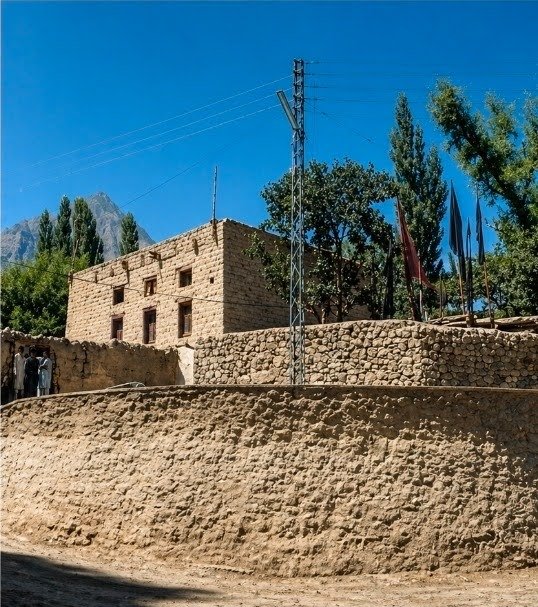
Gurudwara Chota Nanakiana at Skardu is believed to have been visited by Guru Nanak Dev, the founder of Sikhism. He had stayed at this place while he was on his way back from China. It is also called as “Asthan Nanak Pir” by the local people. It is located two kilometres from Skardu Fort. Every year thousands of people come to visit this place in the summer. There is a big building on top of a small hill (about 1 km from the main cross road of Skardu). It is this building which is known as Gurdwara Chota Nanakiana. Prakashasthan (congregation hall), langar (community kitchen), hall, and an inn for pilgrims are on the hill. There are several shops on the main road below this building. These shops are run by this sacred institution. The building is not in a good condition. Prakashasthan has started collapsing and the rest of the building too wears a deserted look. Only the shops remain functional as they are looked after by the occupants.