

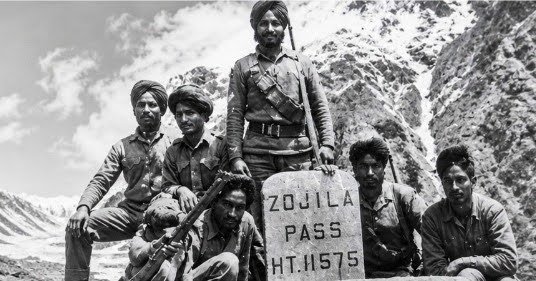
The recapture of Zojila Pass on the 1st of November 1948 holds historical significance as it marked a crucial moment in the war between India and Pakistan which began in October 1947. Zojila Pass is a high mountain pass in the western Himalayas that connects the Kashmir Valley with Ladakh. It holds strategic importance due to its location.
In October 1947, tribal militias supported by Pakistan invaded the princely state of Jammu and Kashmir. On the 26th of October 1947, the state formally acceded to India. The Indian government, in response, dispatched troops to help defend the state. The recapture of Zojila Pass was a crucial part of these operations.
The strategic importance of Zojila Pass
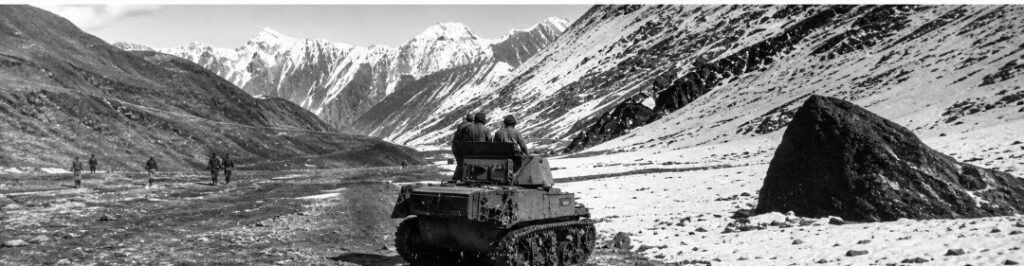
Zojila Pass, located in the western Himalayas, serves as a crucial gateway that connects the Kashmir Valley with Ladakh. Control over it was vital for the movement of troops and supplies between Srinagar (in the Kashmir Valley) and Leh (in Ladakh). Indian forces recognized the significance of Zojila Pass as a lifeline for the region and a potential point of vulnerability. In May 1948, Zojila fell to the Pakistani raiders and it was vital for India that the pass be recaptured before winter so as to relieve Leh. ‘Operation Bison’ was launched to wrest control of Zoji La Pass. Stuart Mk-V light tanks of 7 CAVALRY were moved in a dismantled condition through Srinagar to Baltal.
Operation Bison
The plan for the crucial attack—named ‘Operation Sparrow’, later superseded by ‘Operation Bison’—was issued by Brig Atal on the 14th of October. He had under his command 5 Mahratta, 1/5 RGR, 1 Patiala, and 4 Rajput in place of 3 Jat which was busy elsewhere. The artillery units taking part were 30 Field Battery, 51 (Para) Field Battery and the Jammu and Kashmir Mountain Battery. 7 Cavalry under Lt.Col. Rajindar Singh (popularly known as “Sparrow”) was the primary armoured force with twelve covered carriers also provided. The tanks were to advance through the Zoji La and deal with the formidable enemy positions on Mukand, Chabutra, MMG ridge and North Hill.
A coy of 1 Patiala was to follow them in covered corners to the Gumri area. 1/5 RGR, supported by 30 Field Battery, 51 (Para) Field Battery and Jammu and Kashmir Mountain Battery, was to mop up and capture Mukand from its lower slopes to the other end at ‘small U’, after the tanks had reached Gumri and destroyed the main enemy positions. 1 Patiala (less one coy) was given orders to assault and occupy MMG ridge beyond Mukand. A few platoons of 5 Mahratta were told to occupy high ground near Chabutra, overlooking the Bod Gumbur Nar before D-day, thus preventing the hostiles on Chabutra from launching a counter-attack while Mukand and MMG ridge were being captured. After they were captured, 4 Rajput was to be pushed forward towards Machhol, and the operation was to be continued till the recapture of Drass. Tempests of the RIAF were to give the fullest support to the attack. All details of the crucial operation were carefully worked out, and instructions were issued even about the use of smoke shells in the attack and the regulation of civilian traffic in the Sind valley.
The attack was to begin on the 20th of October and all the arrangements had been completed in time. But on the 18th of October, it started snowing. Heavy snowfall continued on the 19th of October and the 20th of October, burying the newly built track, reducing visibility and making all movement over the steep slopes practically impossible. So the projected attack was postponed to the 25th of October. But it snowed again on the 23rd of October, necessitating a further postponement of the attack to the 29th of October. It proved impossible to begin the offensive even on the 29th of October, as the snow was still thawing and the tracks and hill-sides were too slippery for movement. Finally, the 1st of November was fixed as the D-day. It was very doubtful now if Kargil or even Drass could be captured before the great freeze-up and Brigadier Atal had been clearly told that if the offensive could not begin on the 1st of November, the great attack would finally be abandoned.
The dawn of the 1st of November broke with heavy grey clouds scudding overhead. A chilly wind came screaming down the mountains and a fitful drizzle and light snow followed. The troops were ready and tense, with that peculiar empty feeling in the stomach which even veterans have just before a battle. The attack was to be heralded by a terrific bombardment of the defile at 1000 hours. The snowing continued and no guns roared even after 1000 hours. Many began to think in despair that the attack had been abandoned, and the fate of Leh was sealed. The tension and uncertainty were becoming unbearable when, at 1030 hours, the artillery barrage began. The tanks of C squadron, 7 Cavalry, clattered forward soon after, led by a 15 cwt Dodge with a winch to pull out any tank that stalled or got stuck. An artillery observer (F.O.O.) went forward in one of the tanks to direct the artillery fire at the exact targets. The two armoured car troops of A squadron, 7 Cavalry, followed the tanks at the tail of the column, and one company of 1 Patiala in covered carriers gave close protection. Fortunately, no anti-tank mines were encountered, nor did any tank get stuck in the soft snow. The streams of bullets from the raiders’ MMGs and rifles came furiously, but flattened themselves on the tempered steel of the tanks’ sides, and fell harmlessly to the ground. Most of the hostiles had never seen tanks in action before and were completely demoralised by the iron monsters coming close and blasting their bunkers into smithereens. The violent fury of the shelling added to their terror. Their casualties were very heavy, and the survivors left their positions and fled in utter panic.
The tanks reached Gumri plain by the afternoon. In view of the unexpected collapse of the enemy, 1/5 RGR was ordered to not wait for nightfall but to attack immediately and occupy Mukand, Chabutra, North Hill and MMG ridge. These frowning hills, which had proved so formidable in earlier attacks, now fell after insignificant resistance. By 2115 hours on 1 November, 1 Patiala also reached Gumri, the flanking hills were firmly held and, at long last, the Zoji La defile had been burst open.